







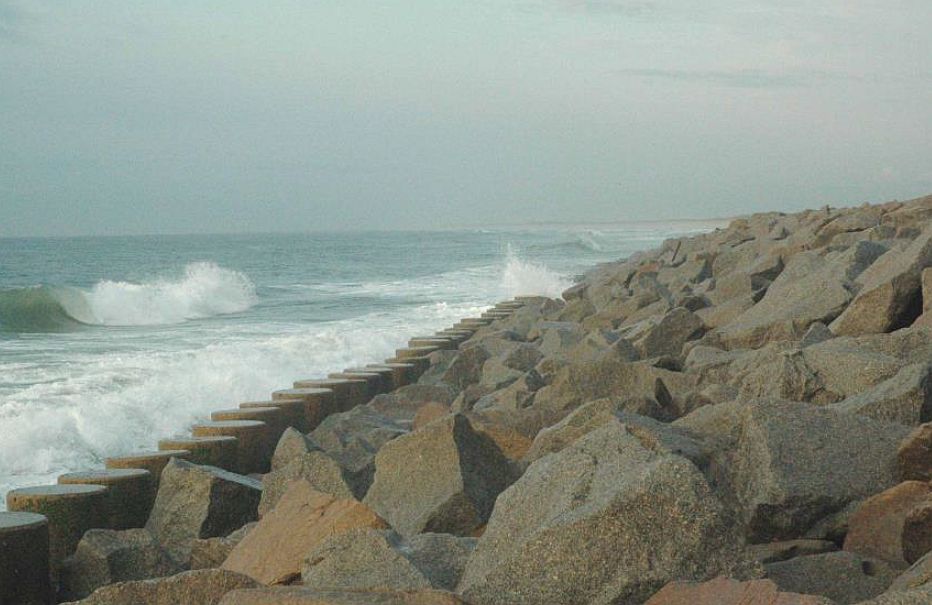
As state lawmakers consider repealing the longstanding ban on seawalls and jetties on North Carolina’s coastline, some of the state’s top scientists are recommending “a cautious approach” to allowing any new hardened structures.
Read more More Americans are hungry in the face of federal cuts, rising grocery prices
The N.C. Coastal Resources Commission Science Panel released a highly-anticipated report Thursday examining various approaches to stabilizing the shoreline against coastal erosion.
Dr. Laura Moore, chair of the CRC Science Panel and a professor in UNC-Chapel Hill’s Department of Earth, Marine and Environmental Sciences, said while the recent storms and the dramatic loss of homes in Dare County have brought the issue to the forefront, North Carolina’s beaches suffer from long-term chronic erosion.
“When construction is based on a 30-year setback and buildings last longer than 30 years, the shoreline will eventually intersect or come close to intersecting the development line,” said Moore. “This is what we’re seeing, and we’ll see more of it in the future.”
The CRC panel was tasked with identifying the best way to protect coastal property — terminal groins, seawalls, retaining walls or other erosion-control measures.
Moore told the commission that each approach has tradeoffs.
Groins can slow erosion and widen a beach in some areas where the sand naturally accumulates, but they can also increase the erosion in areas where sand is already being lost naturally, Moore said.
Shoreline hardening with seawalls and sandbags can be used to absorb energy and reduce wave impacts. But this approach takes up space on the beach. And Moore said maintaining the beach in front of a seawall or hardened structure will actually require greater amounts of sand over time.
“You lose some of the beach and dune profile depending on where the structure is placed,” Moore explained. “Seawalls also reduce sand supply for adjacent beaches because the area that’s armored is no longer available as a sand source.”
The panel examined the use of existing groins, jetties and other sand-trapping methods at Fort Fisher, Fort Macon, Buxton, and Bald Head Island. In each case, maintaining the shoreline required regular beach nourishment and repair once the hardened structures deteriorated.
“All approaches to protecting infrastructure that involve hardening the shoreline tend to produce the same adverse physical effects,” according to the draft report.
Moore said that their research found that in areas where a structural approach led to wider beaches, home values increased and fewer homes were lost. But in areas where the beach narrowed, home values decreased and there was an eventual loss of public beach.
Read more Housing starts sink to pandemic levels as builders worry about inflation
Coastal Resources Commissioner Lauren Salter said she lost her own home to Hurricane Florence in 2019 and understands the emotions of those who’ve lost their homes to the Atlantic Ocean more recently.
“But all I can see in this report is, where you place [the hardened structure], you’re picking who gets protected at the expense of someone else,” said Salter. “How do you choose who benefits and who suffers adverse impacts?”
Moore added that not all tradeoffs can be easily monetized or analyzed. The addition of hardened structures could harm nesting sea turtles, shorebirds, and fish habitats. The ecological impact could impact regional tourism.
The report also recommends that any reconsideration of the ban include a broad assessment of the “benefits, costs, limitations and distribution of effects arising from an expanded use of hard structures” prior to a change in policy.
Senators okay repeal of NC’s hardened structure ban, dismiss buyouts for threatened coastal homes
State lawmakers, however, appear to have made up their minds before the report was even released. Senate President Phil Berger (R-Rockingham) told reporters Wednesday he would support the Senate bill to lift the ban.
“I think we need to do that. We’ve just seen too many examples of the ocean taking fairly large structures. And there’s a solution to that,” said Berger.
Berger said any bill moving forward could be amended based on the report’s recommendations.
Currently, 15 states regulate hardened coastal structures, according to the CRC. Three states – Maine, Rhode Island, and Texas – have passed legislation that don’t allow new hard structures or armoring.
Read more Nationwide survey shows ongoing struggles for pregnant patients on Medicaid