








The share of young children in the U.S. under age 6 who were uninsured increased 23% between 2022 and 2024, according to a new report from Georgetown University’s Center for Children and Families. The report released on Monday found that 220,000 additional babies, toddlers and preschoolers were uninsured in 2024, the most recent year for which data is available.
Read more Brooks Fuller of Common Cause North Carolina on proposals to make voting in our state harder
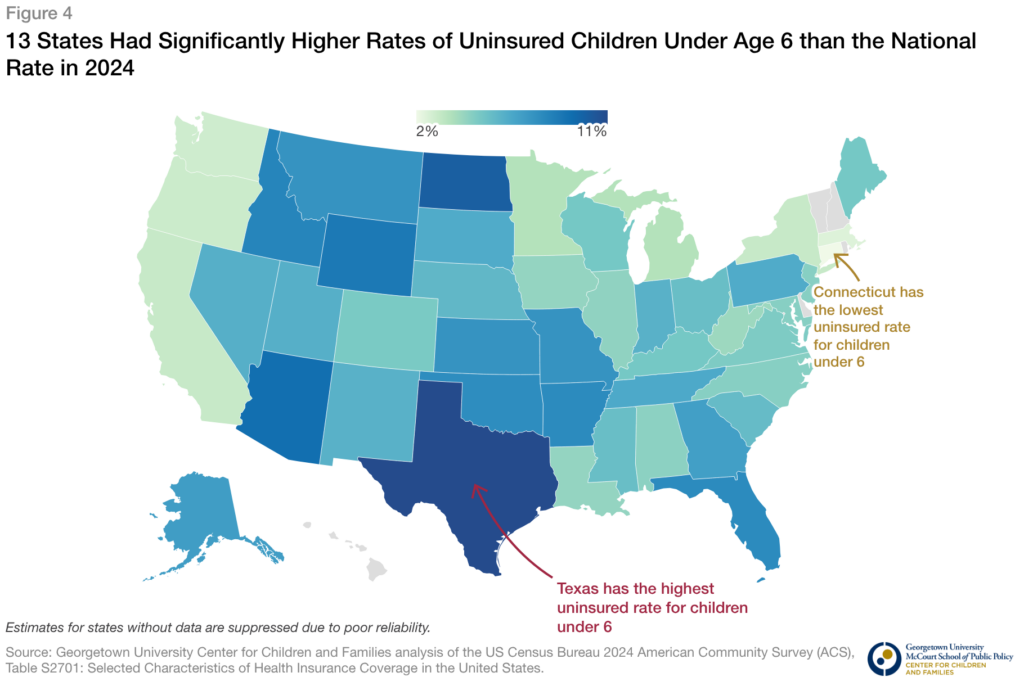
Texas, North Dakota, Arizona, Wyoming, Idaho, Arkansas, Florida, and Oklahoma have the highest rates of uninsured children under 6 nationwide.
North Carolina’s uninsured rate for children in this age group was 4.2% in 2024, below the 5.3% national average. The state had 30,800 children who were uninsured, according to the U.S. Census Bureau.
Joan Alker, executive director of the Center for Children and Families and a research professor at the Georgetown McCourt School of Public Policy, says North Carolina made two decisions during the Cooper administration that benefited thousands of children who would have otherwise lost coverage.
“They were also one of two states in the country — North Carolina and Kentucky — that put a longer hold on their disenrollment for children,” said Alker. “Going fast was really a risky approach, like Idaho took, but going very, very slowly and taking the time to do it right was something that North Carolina and Kentucky did, and that was a good choice.”
Elisabeth Wright Burak, a senior fellow at Georgetown University and a lead author of the report, says North Carolina was also one of just a handful of states that applied to the Centers for Medicare & Medicaid Services for a 1115 waiver, allowing for continuous coverage for children up to age 6.
“Before it sunsets in a few years, we’re hopeful that it will protect a lot of young children in North Carolina,” said Burak. “We’ll have to watch.”
Federal law requires that all states provide children at least 12 months of continuous coverage under Medicaid and the Children’s Health Insurance Program.
Read more Some trans military members banned by Trump allowed to continue service under ruling
Alker said North Carolina’s decision to formally expand Medicaid in December 2023 also provided a “welcome mat” effect, with newly eligible adults seeking healthcare coverage for their children as well.
But Alker worries that nationally, the numbers are now moving in the wrong direction.
Two million fewer children are enrolled in Medicaid and CHIP since Trump took office, said Alker. When child enrollment in Medicaid and CHIP goes down, the uninsured rate for children goes up.
The Congressional Budget Office recently that the number of children covered by Medicaid will decline by 3 million over the next decade as cuts from H.R. 1 – the One Big Beautiful Bill Act – take effect.
Healthcare costs top of mind for voters as midterms approach, survey finds
Some Republican lawmakers and President Donald Trump have said Medicaid expansion is unsustainable. They say the cuts to coverage in the 2025 spending package were needed to offset the cost of tax cuts.
But Alker says lawmakers focused on affordability issues should see health coverage for children as an issue of economic security.
“It’s a great investment of our taxpayer dollars,” said Alker. “Winding up in the emergency room with a broken arm or an asthma attack can really bankrupt a family at a time when they’re already facing such high costs. That’s why even one month of a child being uninsured is too many.”
There’s no paywall here.
As a nonprofit newsroom, our articles are free for everyone to access. Readers like you make that possible. Can you help sustain our watchdog reporting today?
Read more NC housing advocates face challenges from federal funding uncertainty