







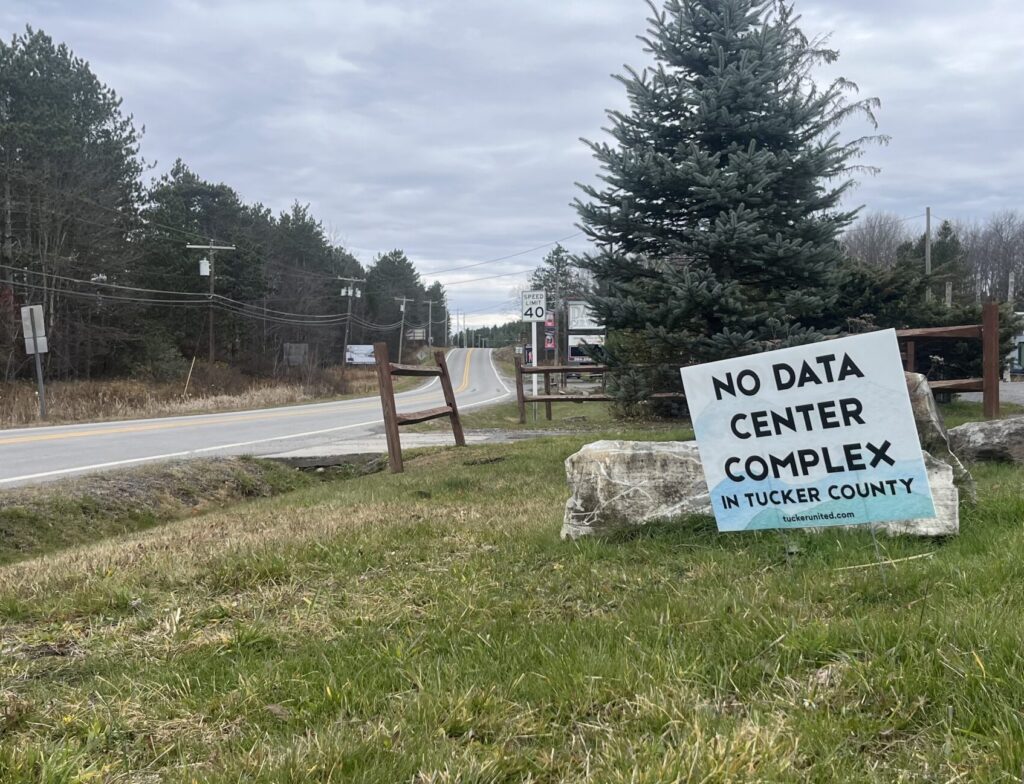
While Tucker County residents spent the last year and a half struggling to get answers from Fundamental Data about its proposed data center and power plant complex, a company representative spoke at a city council meeting nearly 400 miles away and across state lines earlier this month, sharing details about the Tucker County project and urging his own local officials to adopt data center safeguards that West Virginia law doesn’t allow.
Read more North Carolina energy company accused of fraud files for bankruptcy
Ted McGavran, who said he was an engineer with Fundamental Data, appeared at the city council meeting in Belmont, North Carolina — where he lives — on July 6. There, he told his local officials they should consider implementing noise ordinances to ensure that any proposed data center projects — especially those using diesel generators as backup power, which is the plan proposed for Fundamental Data’s Ridgeline Project in Tucker County — don’t disrupt the surrounding town.
“We’ve got a small town, a small compact town, and so a diesel generator makes noise,” McGavran said.
In West Virginia — where McGavran is working for Fundamental Data to develop what could amass to a 10,000 acre complex between Tucker and Grant counties that would house data centers, a natural gas power plant and diesel backup generators — state law prohibits localities from implementing any laws that would impact data center developments, including noise, light and zoning ordinances, among others.
That section of code came from House Bill 2014, which passed the state Legislature in 2025 and created the state’s certified microgrid and data center program.
At the Belmont City Council meeting, McGavran alleged that Fundamental Data was responsible for crafting that legislation.
“We were the guys who basically wrote (HB 2014) and got it through the (West Virginia) Legislature in 2024 and early 2025,” McGavran said. “That gave us the opportunity to generate and set out the rules for what’s called a microgrid. Well, it’s really a ‘macrogrid,’ as big as it’s going to be.”
Because of that role and the project’s proposed reliance on its own natural-gas fired power plant microgrid, McGavran said Fundamental Data “can do pretty much whatever we want to do up there.”
HB 2014 was introduced by request of Gov. Patrick Morrisey nearly halfway through the 2025 legislative session. It was one of his highest priorities outlined for the Legislature that year.
Fundamental Data filed an with the state Department of Environmental Protection the same day the bill was introduced.
In a statement Tuesday evening, Morrisey spokesman Lars Dalseide denied McGavran’s assertion that Fundamental Data had any role in drafting the bill.
“HB 2014 was the Governor’s bill, and its drafting was deliberately limited to the Governor’s office to ensure the legislation reflected Governor Morrisey’s vision and priorities,” the statement read. “While we can’t speak to Fundamental’s interactions with legislators once the bill was introduced, HB 2014 was shepherded through the legislative process by the Governor and his staff.”
Elected officials in the area — including Senate President Randy Smith, numerous other members of the Legislature, local mayors and members of the Tucker County Commission as well as the county’s Development Authority — have repeatedly denied having any knowledge of Fundamental Data or the proposed project before the air quality permit application was filed and first noticed by local resident Pamela Moe in a legal advertisement in the Parsons Advocate.
In a social media post Thursday morning, Morrisey said McGavran “is fabricating this story.”
“He should be ashamed of himself. No respectable company would allow someone who represents them to mislead the media and public like this,” Morrisey wrote on X, formerly called Twitter, in response to this article. “I’ve been worried about how this company has handled itself from the beginning. They need to do much better. Shame on them.”
Fundamental Data did not respond to multiple questions sent via email for this story.
The company did give a statement to Country Roads News on Thursday, where they denied McGavran’s claim regarding the crafting of HB 2014.
“Fundamental Data did not draft, write, or play any role in drafting HB 2014. Mr. McGavran is not authorized to speak on behalf of the company. Any comments he may have made or may make are solely in his personal capacity and should not be attributed to Fundamental Data,” a spokesperson told the outlet. “Accordingly, we are not in a position to comment on or characterize Mr. McGavran’s personal statements. Our position is limited to the company’s own involvement, which is straightforward: Fundamental Data played no role in drafting the legislation.”
Read more As vote on Blanche for attorney general nears, ex-DOJ staffers warn against confirmation
McGavran could not be reached by phone and did not respond to a message seeking comment by press time for this article.
Amy Margolies, executive director of the grassroots organization Tucker United, which formed last year to find more information about the Fundamental Data project, said the comments made by McGavran give new life to old questions and concerns. It was also frustrating, she said, to see a representative for the company share information so openly in another state while those in Tucker County have largely been left in the dark on the project.
“Having had so much difficulty getting basic information from this company for over a year, it is very frustrating to hear them willingly sharing more information than we’ve ever gotten about the project that’s going to affect our lives,” Margolies said.
She said she couldn’t sleep after watching the video of the Belmont City Council meeting and hearing the details shared by McGavran, which included confirmation that the proposed complex will run on about three to five gigawatts and, without question, will be connected to data centers.
“It’s hard to say who is telling the truth anymore,” Margolies said. “If (McGavran) is truthful in saying Fundamental Data crafted HB 2014, then we have real concerns about them writing these rules for themselves with no concern for our community, and with (state leaders) for allowing this. But maybe that’s not true. Either way, we’re left here, again, with so many questions and fewer answers than before.”
Margolies said it was hard not to be offended by some of the statements McGavran made about Tucker County and the surrounding communities, including the assertion that the company can do “whatever” it wants in the region.
McGavran also said — while urging his own local officials to consider whether a data center was the right fit for their community — that the area around Tucker County was ideal for such developments because it’s “in the middle of nowhere.”
“It’s hard to hear that and think about anything other than the fact that they have very little regard for our community and really feel, as he said, that they can do whatever they want, no matter what we say,” Margolies said. “That’s scary to consider. We’re real people. We live in these towns and we are directly impacted in very real ways by the actions of this company. This is our lives, our kids’ lives, and our lives should not be an economic experiment.”
And most frustrating, Margolies said, was hearing an engineer for Fundamental Data urge protections like noise ordinances for his own community while working on a project in her hometown and taking credit for a law that stops her and her neighbors from having the same sort of guardrails.
“It’s so hypocritical, and yeah, it’s unfair. It’s unfair to the people of West Virginia, the people of Tucker County, to be held to a different standard of safety, a different standard of wellbeing and health than his own community in North Carolina would hold for themselves,” Margolies said. “It makes us feel like we’re expendable. It’s this pattern of treating communities and people in West Virginia like they have less value. But that’s not true, and it’s concerning to hear from a company that wants to locate and work here.”
And the comments made by McGavran — who spoke mostly in definitive statements about the plans for Tucker County — were much different in tone than recent assertions made by Fundamental Data, which has insisted in communications to the state Department of Commerce that the project remains in the “conceptual” phase.
Last month, Commerce officials cited Fundamental Data for flouting a state law that requires companies intending to build microgrids or high impact data centers to apply for certification from the state within 10 days. Fundamental Data pushed back, saying the plan remained in the “conceptual phase,” and as such no violation existed. Representatives walked back previous statements that suggested the plans were more concrete. The state then rescinded its violation, but raised new questions about who owns the land Fundamental Data intends to locate on.
Andy Malinoski, the director of communications and marketing for the state’s economic development division, said in an emailed statement Wednesday evening that Commerce is aware of the statements made by McGavran.
“However, remarks and informal public statements do not substitute for formal regulatory filings under West Virginia law. The Department enforces House Bill 2014 and the data center framework strictly based on verified legal documentation, formal applications, and binding developer commitments,” Malinoski wrote. “Should new documentation or filings indicate a project has progressed beyond the conceptual stage, we will enforce all compliance requirements accordingly.”
For Margolies, it’s difficult to see how the comments made by McGavran earlier this month would apply to a plan that is still in a “conceptual” phase.
“It seems very clear that this is a project they’ve been working on for some time prior to HB 2014, which they now claim to have had a role in drafting. The reason why we want to have guardrails for these projects is to prevent bad actors from taking advantage of our community,” Margolies said. “In the end, our lives are not conceptual. We’re real people. We have real lives and real children, and so we have to take this seriously.”
This story was originally produced by West Virginia Watch, which is part of States Newsroom, a nonprofit news network which includes NC Newsline, and is supported by grants and a coalition of donors as a 501c(3) public charity.
Read more US House approves joint measure to curb Congress’ stock trading, require voter ID