

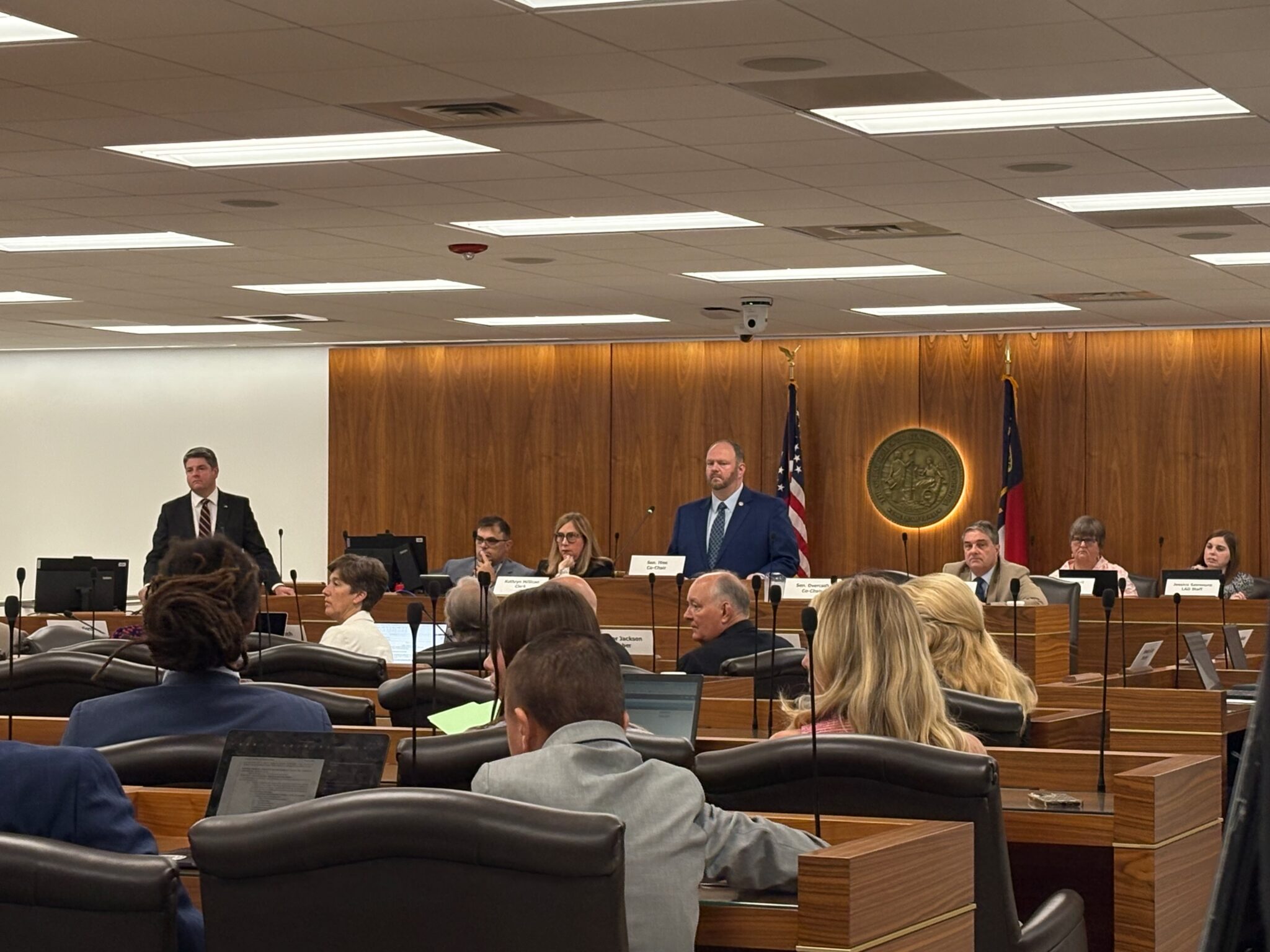
The North Carolina Senate Elections Committee advanced a pair of election law bills Tuesday, drawing mixed reactions from voting rights advocates.
Read more NC Auditor: $111 million spent on Hurricane Helene emergency camps
The first bill, House Bill 834, received mostly praise, as it extends the period during which voters are able to cure problems on their ballots from three business days after the election to five business days after the election, among other reforms. And it allows voters whose driver’s license expiration was put on hold last year to continue using them as valid voter IDs.
But that bill also expands the number of forums for challenges to State Board of Elections decisions, which are currently heard in Wake County Superior Court, by also allowing them to be brought in the superior court of the county where the petitioner resides — a change that advocates say would allow judge-shopping and could lead to an increase in frivolous challenges to lawful votes.
Lawmakers on the Senate Elections Committee removed the original language of H834, which would have allowed hunting and fishing license applicants to also register as organ donors or voters, replacing it with this new set of proposals. This version of the bill has not yet been considered by the House.
That bill passed the Elections Committee without any opposition.
NC Auditor Boliek expressed polling site preferences and looked to boost GOP turnout, messages show.
By contrast, House Bill 958 has been the subject of controversy for months, sparking protests in the House committees in which it was heard, leading to the ejection of members of the public from a hearing. But much of that bill’s language was stripped out by the Senate, with their version cut down to 16 pages from the House’s original 37.
Sen. Warren Daniel (R-Burke), who introduced the bill, said he hopes to safeguard and streamline the state’s elections processes, highlighting sections such as a requirement for an attestation that a voter is a U.S. citizen when registering to vote.
“The general intent of the bill is to aid elections administration and also continue our effort to secure and ensure election integrity,” Daniel said. “It requires the state board to create a process for removing non-eligible citizens’ voter registration records if the registered voter appears on information received by the state board in a federal database.”
That provision, among the most contentious kept intact by the Senate, requires the state Board of Elections to vet voter rolls against federal noncitizen registries such as the USCIS SAVE database, which is known to have significant errors that have caused thousands of lawful voters to be wrongly flagged in other states.
The Senate also kept in place a requirement for post-election audits by the state auditor, with all county boards of elections undergoing an audit at least once every six years. These may only occur after the election has been certified and cannot be used to challenge election results.
A Senate addition to the bill shortens the early voting period before primary elections to 10 days, long a policy priority for Senate President Pro Tem Phil Berger (R-Rockingham). Like the new ballot curing deadline, it would also extend the deadline for challenging early and absentee ballots to five business days after the election.
Senators removed a requirement for a “uniform statewide audit” after each election for any ballots that are ineligible “as evidenced by official government database records.” They also excised one of the most controversial sections of the bill, which would have imposed new restrictions on military and overseas voters.
Read more NC voters support sports betting but don’t like prediction markets, new poll finds
The House version would have required military and overseas voters to include a photo ID when mailing in their ballots, a requirement that some lawmakers and advocates said could be impossible to fulfill for some service members in the field or other individuals in areas where traveling with the required documents could be unsafe.
The requirements that the House version of the bill imposed on military and overseas voters prompted opposition from some House lawmakers whose support would likely be needed to override a potential veto of the bill from Gov. Josh Stein. All Democrats and both unaffiliated House lawmakers voted against its passage.
The Senate also removed a provision that would have formally banned the counting of votes by so-called “never residents,” voters born overseas who had been granted eligibility to vote in North Carolina because their parents last resided in the state. Those voters, however, remain ineligible under a Wake County Superior Court ruling earlier this year.
Much of the public comment during the committee meeting centered on concerns about the auditor’s new election role.
“The audit process can be manipulated to focus on specific discrepancies to favor one political party or another,” said Mark McClure, a member of Democracy Out Loud. “Similarly, the auditor can sound the alarm about minor errors in predominantly Democratic areas and ignore significant issues in Republican areas, thereby undermining trust in election integrity in targeted counties and statewide.”
Jim Womack, a member of the North Carolina Election Integrity Team and the former Lee County GOP Chair, said the bill has “substantially improved” from its House iteration, though he expressed concern about voter rolls being listed as a component of the state auditor’s post-election review.
“Voter rolls really need to be audited prior to the election, not post-election, because they don’t really help you as much,” Womack said. “I hope that this language does not restrict the state auditor from doing pre-election audits of the voter rolls.”
H958 passed the committee as well, though unlike the first bill, it received opposition from Democratic senators.
Should H958 pass, most of its provisions won’t take effect until on January 1, 2027, for any elections occurring after that date. One key exception is the requirement to check government databases for ineligible voters, which takes effect immediately.
Most of the provisions from H834 would take effect immediately, however, potentially making changes to the ways ballots are counted and challenged for the 2026 midterm elections.
Read more Haitian immigrants brace for end of protected status